
If you’re planning to live and work remotely from Thailand, the visa you need is almost certainly the Destination Thailand Visa (DTV). It’s a five-year, multiple-entry visa built for remote workers, freelancers, and business owners earning income from outside Thailand. For most digital nomads, it beats a regular tourist visa, and it’s a much simpler path than the Long-Term Resident (LTR) Visa, which is really aimed at a smaller group of higher earners.
That said, “best” depends on your income, your savings, and how long you actually want to stay. Here’s a breakdown of the real options, who each one suits, and what to watch out for before you apply.
Visa rules change, and 2026 has already brought a few shifts. Treat the numbers here as a starting point, and confirm current fees, thresholds, and requirements with the official Thailand e-Visa portal.
Official Portal: https://application.royalthaiembassy.com/
Why Border Runs and Tourist Visas Don’t Cut It Anymore
For years, plenty of remote workers got by on tourist visas and visa exemptions, hopping across a border every couple of months to reset the clock. That approach has gotten a lot less workable.
Thailand’s Cabinet approved rolling back the temporary 60-day visa exemption to 30 days for most nationalities in May 2026 (we’ve covered what the new 30-day rule actually means in more detail), and immigration officers are paying closer attention to repeat entries that don’t have a clear purpose. Land border crossings under the visa exemption scheme are also capped at twice per calendar year for many travelers. If you’re trying to build a life in Thailand around a string of short tourist stays, you’re now working against the system rather than with it.
None of this is really about digital nomads specifically. It’s part of a broader tightening of how Thailand manages long-stay foreigners. But it does mean that if remote work from Thailand is part of your plan for more than a few months, you need an actual long-stay visa, not a workaround.
The Destination Thailand Visa (DTV): The Main Option for Most Nomads
The DTV, officially launched in mid-2024, was built for exactly this situation. It lets you live in Thailand for extended periods while working for employers or clients based outside the country.
Here’s the basic shape of it:
- Validity: Five years from issue, multiple entries
- Stay per entry: Up to 180 days, with one extension of another 180 days available at a local immigration office (for a small fee)
- Financial requirement: Bank statements showing roughly 500,000 THB in savings (around $14,500 USD), covering the last three months. See our guide to meeting the financial proof requirement if you want the details on how to document this properly.
- Application fee: In the range of 10,000 THB, though this varies by embassy and country. We break down the full current fee structure here.
- Where to apply: Through a Royal Thai Embassy or Consulate, or via the official Thailand e-Visa portal, from outside Thailand
That last point matters: applications submitted while you’re physically inside Thailand are increasingly flagged and rejected. The system checks location data during the upload process, so don’t try to apply while you’re already in the country on a different visa. Processing itself typically takes a few business days, though it’s worth checking our current processing time estimates before you plan around a specific date.
Who Actually Qualifies
The DTV covers three categories:
Workcation. This is the one most remote workers and freelancers will use. It covers people employed by companies registered outside Thailand, freelancers with clients abroad, and business owners earning foreign income. The key requirement is straightforward: your money needs to come from outside Thailand, and you need to be able to prove it with contracts, invoices, or employment verification.
Thai Soft Power. This covers people coming to Thailand for extended cultural, educational, or wellness programs, things like Muay Thai training, Thai cooking courses, or medical treatment. Programs generally need to run at least six months to qualify, and short courses have been getting pushed toward standard Education visas instead. Thai language schools were also removed from the qualifying list, so if learning Thai is your main goal, this isn’t the route.
Dependents. Spouses and children under 20 can apply alongside a primary DTV holder, each with their own application and fee. Dependents can also work remotely for foreign employers under the same framework.
What the DTV Does Not Let You Do
This trips people up more than almost anything else: the DTV is a long-stay visa, not a work permit. You cannot work for a Thai-registered company, take on Thai clients, or earn Thai-sourced income on this visa. If your work involves invoicing anyone based in Thailand, or you want a job at a local company, you’ll need a Non-Immigrant “B” visa and a proper Thai work permit instead.
The LTR Visa: Built for a Different Kind of Applicant
The Long-Term Resident (LTR) Visa is Thailand’s other major long-stay option, and it’s aimed at a smaller, higher-income group. It offers a 10-year stay (structured as two 5-year periods), work authorization, and some tax benefits for qualifying income.
The catch is the bar to get in. The LTR generally requires a much higher income threshold, often cited around $80,000 a year or more depending on the category, along with more extensive financial documentation and, in some categories, ties to an established employer or investment. It’s a strong option if you clearly qualify and want a longer runway with fewer renewals, but it’s overkill (and often out of reach) for most freelancers and early-career remote workers.
DTV vs. LTR vs. Tourist Visa: A Quick Comparison
| DTV | LTR Visa | Tourist Visa | |
|---|---|---|---|
| Validity | 5 years | Up to 10 years | Typically 60 days, extendable |
| Max stay per entry | 180 days (extendable to 360) | No fixed re-entry limit | 60 days plus possible extension |
| Financial requirement | ~500,000 THB in savings | High income or investment threshold (varies by category) | Proof of funds for the trip |
| Work rights | Remote work for foreign employers/clients only | Work authorization included in some categories | None |
| Best for | Most remote workers and freelancers | High earners, established professionals, retirees with strong finances | Short visits, not long-term remote work |
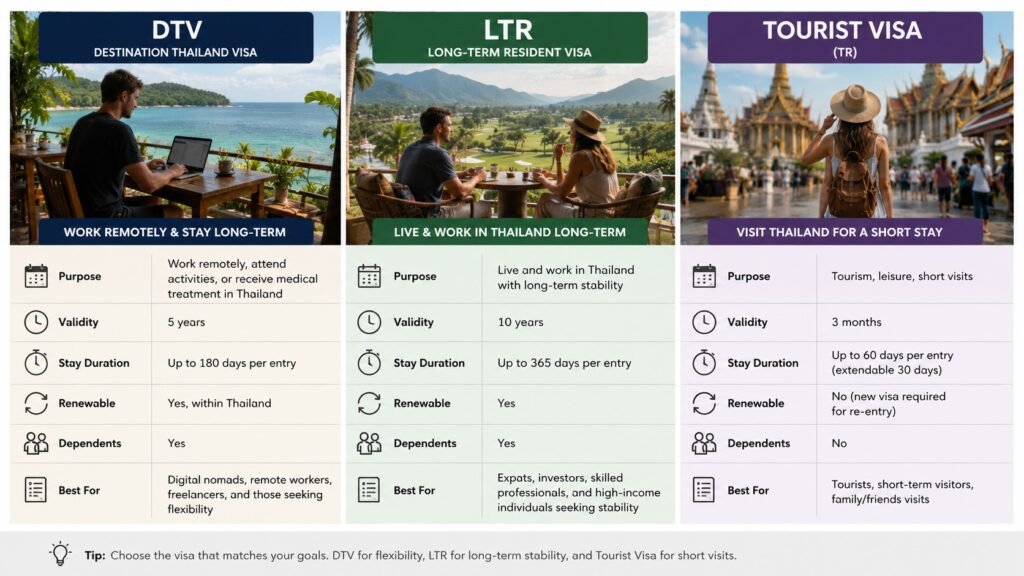
A Quick Way to Figure Out Which One You Need
Ask yourself these questions in order:
- Where does your income come from? If it’s entirely foreign-sourced (employer or clients based outside Thailand), you’re in DTV or LTR territory. If you need to work for a Thai company or take on local clients, neither of these visas will cover you, you’d need a work permit instead.
- How much do you have in savings, and what’s your annual income? If you’re around the 500,000 THB savings mark but don’t clear a high income threshold, the DTV is your realistic option. If you comfortably clear the LTR’s income requirements and want the longer runway, it’s worth considering.
- How long do you want to commit to Thailand? If you’re testing things out for a year or two, the DTV’s flexibility (exit and re-enter as needed) suits that better than committing to LTR’s more involved qualification process.
- Do you want work authorization for Thailand itself, or just to work remotely while living there? If it’s the latter, the DTV covers you. If you actually want to work locally, you’re looking at a different visa category entirely, not either of these.
For the large majority of freelancers, remote employees, and small business owners, that process points straight to the DTV.
Documents You’ll Need for a DTV Application
- Passport valid for at least six months, with the standard bio-data page
- Recent passport-style photo, plain background (we’ve got specific photo requirements and common rejection triggers if you want to get this right the first time)
- Bank statements for the past three months, showing the required savings
- Proof of employment or client relationships: an employment letter, freelance contracts, invoices, or a business registration if you run your own company
- Proof of your current location outside Thailand at the time of application
Some embassies ask for extra documentation on top of this, and requirements can vary by consulate. Our full visa document checklist walks through what to prepare in more detail, but it’s still worth confirming against your specific embassy’s page before you submit.
Common Mistakes That Get Applications Rejected
Weak proof of foreign income. A vague description of “freelance work” without contracts or invoices is one of the most common reasons applications get bounced back. If you’re a freelancer, come prepared with actual paperwork: signed contracts, recent invoices, a professional portfolio, whatever demonstrates an ongoing, verifiable income source.
Large deposits made right before applying. Immigration officers and embassies pay attention to how long funds have been sitting in an account. A big transfer made a week before you apply looks different than three months of steady, established savings. Build in time before you submit.
Applying from inside Thailand. As mentioned earlier, the system is set up to catch this. Apply from your home country or wherever you’re currently based outside Thailand.
Underestimating the Soft Power category’s requirements. If you’re going the cultural or wellness route, make sure your program runs long enough (generally six months) and comes from a qualifying provider. Short courses increasingly don’t meet the bar.
What About Taxes?
This is worth taking seriously, and it’s genuinely more complicated than most quick-start guides make it sound. Thailand generally treats you as a tax resident once you spend 180 days or more in the country in a calendar year. Past that point, income you remit into Thailand, even money earned abroad, can become taxable under current rules.
The exact implications depend on your citizenship, where your income is earned, and any tax treaty between Thailand and your home country. This isn’t something to guess your way through. If you’re planning to spend real time in Thailand on a DTV, it’s worth talking to a tax professional who’s familiar with both Thai residency rules and your home country’s requirements before you commit to a long stay.
How to Apply
- Confirm your category. Workcation, Soft Power, or Dependent, based on your situation.
- Gather your documents. Passport, photo, bank statements, and proof of income or program enrollment.
- Apply through the official channel. Either a Royal Thai Embassy or Consulate, or the official Thailand e-Visa portal, from outside Thailand.
- Wait for processing. Timelines vary by embassy and season, so check current processing estimates for your specific location rather than assuming a fixed number of days.
- Enter Thailand and complete arrival requirements. This includes the Thailand Digital Arrival Card (TDAC), which is required in advance of arrival, and, if you plan to stay somewhere for more than 90 days, address reporting with local immigration.
If any part of your documentation is unclear, whether that’s how to present freelance income or what an embassy specifically wants to see, it’s worth having someone check your application before you submit it. A rejected DTV application costs you time and, in some cases, the application fee itself.
Frequently Asked Questions
Can I work for a Thai company on a DTV? No. The DTV only permits remote work for employers or clients based outside Thailand. Working for a Thai company or taking on Thai clients requires a different visa and a work permit.
Do I need a visa to work remotely from Thailand at all? Yes, if you’re staying long-term. Tourist visas and visa exemptions aren’t designed for ongoing remote work, and Thailand has been tightening enforcement around exactly this kind of use.
How long can I stay on a single DTV? Up to 180 days per entry, with the option to extend once for another 180 days at a local immigration office, for a maximum of 360 consecutive days per entry. The visa itself is valid for five years, so you can exit and re-enter as needed.
Is the DTV a path to Thai residency or citizenship? No. It’s a long-stay visa, not a residency or citizenship pathway.
What if I don’t qualify for either the DTV or the LTR? It’s worth reviewing standard Non-Immigrant visa categories, which cover situations like formal employment with a Thai company, marriage to a Thai national, retirement, or education. These have their own separate requirements.
Before You Apply
Visa rules are not static, and Thailand’s immigration policy has shifted more than once in the past couple of years. Before you submit anything, confirm the current fees, savings thresholds, and processing times directly with the official Thailand e-Visa portal or your nearest Royal Thai Embassy or Consulate.
If you’d like help making sure your application is complete and accurately documented before you submit it, our team can review your paperwork and walk you through the process. We don’t issue visas ourselves, that’s entirely up to Thai immigration authorities, but we can help you avoid the common mistakes that lead to delays or rejections.