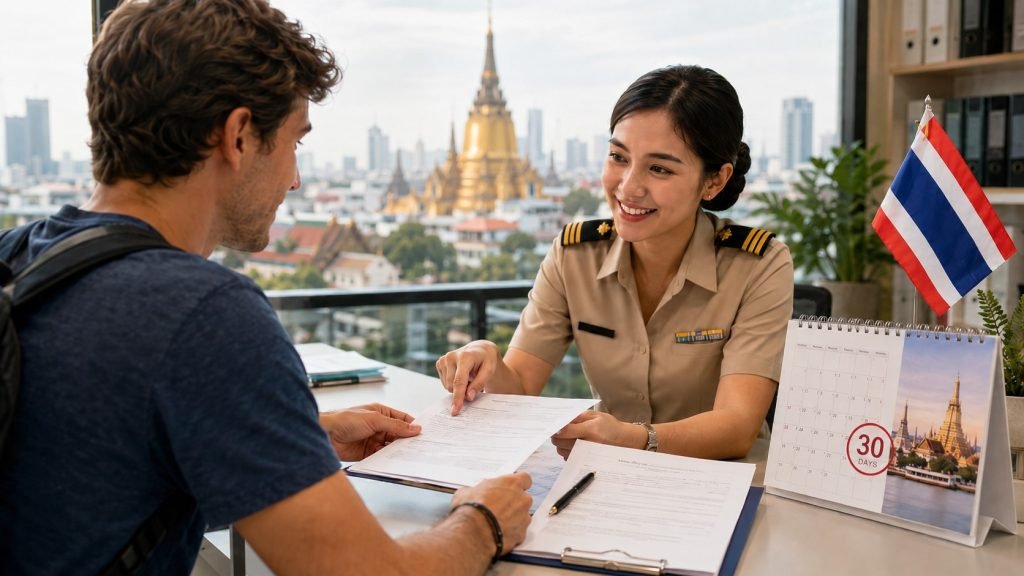
Your time in Thailand is winding down, but you are not ready to pack your bags. Coping with local bureaucracy can feel overwhelming when you just want to enjoy your trip.
If you miscalculate your dates or bring the wrong paperwork, you risk facing expensive penalties or stressful delays at the airport. The internet is filled with conflicting advice about which offices are open and what documents are required.
Getting a 30-day visa exemption extension is straightforward when you have the exact steps. This guide cuts through the confusion so you can secure your extra month with total confidence.
Official Portal: https://application.royalthaiembassy.com/
What You Need for a 30-Day Thai Visa Extension (Document Checklist)
Before you head out the door, you must gather your physical paperwork. Missing a single photocopy will send you to the back of a very long line.
The Immigration Bureau Thailand enforces strict requirements for every applicant. Prepare these items the night before your visit to ensure a smooth counter experience.
- Your original passport: It must be valid for at least six months from your application date.
- Passport photocopies: You need signed copies of your main photo page, your current visa or entry stamp, and your TM.6 departure card if you received one.
- Official passport photo dimensions: Bring one recent 4×6 cm photo with a white background. Do not use standard western passport sizes.
- The application fee: Prepare the exact amount.
Demystifying the TM.7 Application and TM.30 Residence Notification
You will need to complete the TM7 application form once you arrive at the immigration office. Write clearly using black or blue ink. Double-check that your signature matches the one in your passport exactly.
The real stumbling block for most travelers is the TM30 notification of residence. Under Thai law, your hotel, hostel, or landlord must report your stay to the government within 24 hours of your arrival.
If your host neglected this duty, immigration officers might reject your extension request on the spot. Always ask your accommodation manager for a printed copy of your TM.30 receipt before you leave for the immigration office. For complex situations, checking the latest official guidelines from the Royal Thai Embassy can save you an unnecessary trip.
Where and How to Apply: A Walkthrough of Thai Immigration Offices
The application process must be completed in person. Plan to arrive early in the morning, ideally 30 minutes before the doors open, to secure a low queue number.
Your physical location determines where you must go. If you are staying in Chiang Mai or Phuket, you will visit their respective provincial immigration offices.
In Bangkok, the processing location changes depending on how you entered the country. Most tourists who arrived via a standard flight must go to the major complex at Bangkok (Chaengwattana / Muang Thong Thani). Always confirm the active location with local authorities before ordering a taxi.
Costs, Limits, and Overstay Rules for Thai Tourist Visas
The standard Thai visa extension fee is exactly 1,900 Baht. You must pay this using a cash payment Thai Baht, as credit cards are not accepted at the counters.
Under the Immigration Act, B.E. 2522, an overstay fine costs 500 Baht per day. It maxes out at 20,000 Baht, but serious violations can lead to detention and deportation.
Choosing between an extension and a border crossing depends on your budget and itinerary. Here is how the two options compare:
| Feature | 30-Day Immigration Extension | Border Bounce (Exemption Re-entry) |
| Cost | 1,900 Thai Baht | Cost of transport, flights, or visa runs |
| Time Required | 2 to 5 hours in a local office | 1 to 2 full days of travel |
| Location | Inside your current Thai city | International border checkpoint |
| Frequency | Typically allowed once per entry | Subject to strict calendar-year limits |
The interactive tool below helps you calculate your specific deadlines and requirements. Use your exact entry date to find out when to visit the office.
Frequently Asked Questions
How much does it cost to extend a Thai tourist visa for 30 days?
An extension costs exactly 1,900 Thai Baht. This flat fee applies across all official provincial immigration offices nationwide. You must pay this amount in physical cash, as digital transfers and international cards are unavailable.
What documents do I need for a 30-day Thai visa extension?
You need your original passport, signed photocopies, a 4×6 cm photo, a completed TM.7 form, and a TM.30 residence receipt. Leaving out any of these elements will result in an immediate rejection. Make sure your photocopies show your passport photo page and your latest entry stamp.
Where can I extend my tourist visa in Bangkok?
Extensions are typically processed at the Chaengwattana Government Complex or the Muang Thong Thani center. The correct location depends on your current visa type and recent administrative updates. Confirm the active office location directly with official announcements before starting your journey.
Can I extend my 30-day Thai visa exemption online?
No, you must visit a physical immigration office to complete the extension process in person. The government offers online portals to download forms, but officers must physically stamp your passport. You cannot bypass the in-person counter queues or cash payments through an app.
How many times can you extend a tourist visa inside Thailand?
You can generally extend your tourist stay only once per entry for an additional 30 days. To stay longer, you must leave the country or transition to a different visa category. Attempting multiple consecutive extensions on the same entry is not permitted under local regulations.
Official Portal: https://application.royalthaiembassy.com/