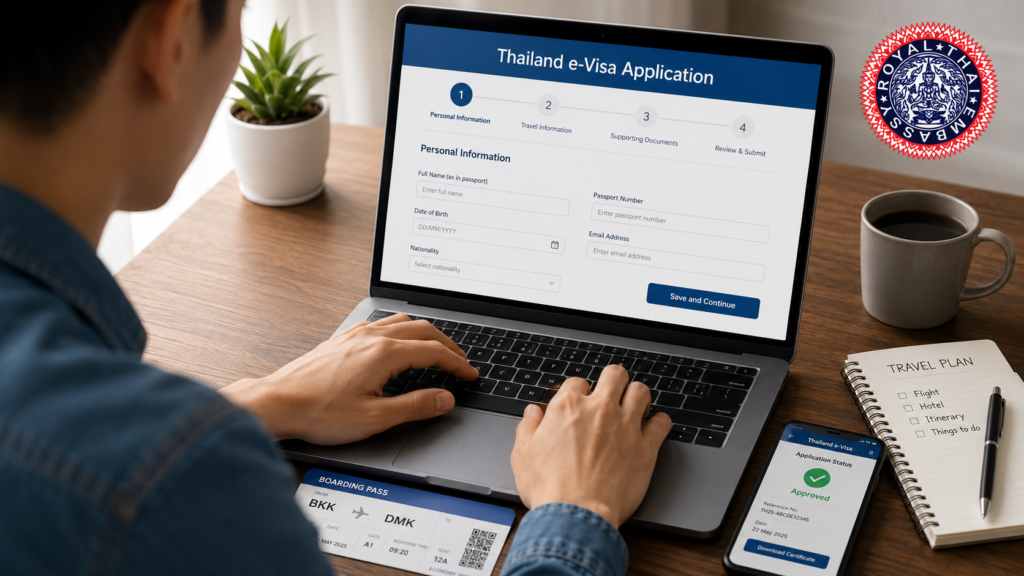
If you’re staring at a half-finished Thailand e-Visa application right now, wondering whether you picked the right passport type or if your bank statement is going to cut it, you’re not alone. Most of the confusion around this process doesn’t come from the application itself. It comes from not knowing which parts actually matter and which parts you can breeze through.
This guide walks through the parts people get stuck on: figuring out if you even need an e-Visa, getting your documents in order, avoiding the mistakes that cause delays, and knowing what to do if something goes wrong after you’ve already submitted.
First, Make Sure You Actually Need an e-Visa
Not everyone applying for a Thailand trip needs to go through the e-Visa process. Thailand runs three separate entry systems, and picking the wrong one wastes time and, in some cases, money you won’t get back.
Visa exemption. If you’re a citizen of an ASEAN country like Malaysia, Singapore, or the Philippines, or you hold a passport from countries such as the United States, United Kingdom, Canada, Australia, or most EU member states, you can likely enter Thailand for tourism without applying for anything in advance, for a set number of days depending on your nationality and entry point.
Visa on Arrival (VOA). A smaller list of nationalities, including the Maldives and Bhutan, can get a short-stay visa stamped at the airport without applying online first.
e-Visa. If you don’t qualify for either of the above, or you want a longer stay or a specific visa category like study, work, or long-stay, you’ll need to apply for an e-Visa before you travel. This covers travelers from a long list of countries, including Bangladesh, Pakistan, Nepal, most African nations, and much of the Middle East and Central Asia.
If you’re not sure which category you fall into, check your eligibility before you start filling out any forms. Applying for a visa you don’t need, or applying under the wrong category, is one of the easiest ways to lose time and money on this process.
Where to Actually Apply
Here’s something that trips a lot of people up, and it’s worth being direct about it. The official Thailand e-Visa is https://application.royalthaiembassy.com. That’s where your application is ultimately reviewed and approved. No private company issues Thai visas.
What a service like Royal Thai Embassy does is different: it helps you prepare and submit a complete, correctly filled application, checks your documents before submission, and provides support if something needs fixing along the way. Think of it as application assistance, not the government process itself. If you’d rather handle the government portal entirely on your own, that’s always an option too. If you want help getting the details right the first time, particularly for tourist visas, work and business visas, or study visas, that’s where a service like this earns its fee.
Either path gets you to the same place. What matters is that your paperwork is accurate and complete before it goes in.
The Documents You’ll Actually Need
Requirements shift slightly depending on which visa category you’re applying for, but nearly every applicant needs the following:
- Passport biodata page. A clear, full-color scan of the photo page. Blurry or cropped scans are one of the most common reasons applications get sent back for correction.
- Recent photograph. Taken within the last six months.
- Proof of your current location. Something showing where you’re applying from.
- Travel booking confirmation. Evidence of your trip, not necessarily a fully paid ticket, but something showing planned travel.
- Proof of accommodation in Thailand. A hotel booking or an invitation letter if you’re staying with someone.
If you’re applying as a student or worker, expect to provide more. Based on the current requirements for these categories, that includes financial evidence such as bank statements or a sponsorship letter, an enrollment confirmation letter from your school signed by an authorized person, or for workers, a WP32 approval letter from the Ministry of Labour (Japanese applicants are exempt from this particular requirement). If any of your documents aren’t in English or Thai, budget extra time for translation before you submit.
Before you upload anything, check that scans are legible, current, and match the name and details on your passport exactly. Mismatched spelling or a passport number typo is a fast way to get an application rejected outright.
Passport Validity: The Rule People Miss Most
Your passport needs to be valid for at least six months from your date of arrival in Thailand. This is a hard requirement, not a suggestion, and it’s easy to overlook if you’re focused on the visa itself rather than the document carrying it.
If your passport is getting close to that six-month window, renew it before you start your e-Visa application. Applying with a passport that’s too close to expiry is a guaranteed rejection, and by the time you find out, you may not have enough time left to renew and reapply before your trip.
Single Entry vs. Multiple Entry: Which One Do You Actually Need
Thailand’s tourist e-Visa comes in two versions, and picking the right one from the start saves you a second application later.
| Single Entry eVisa (SEV) | Multiple Entry eVisa (MEV) | |
|---|---|---|
| Validity | 3 months from date of issue | 6 months from date of issue |
| Stay per visit | Up to 30 days | Up to 60 days |
| Extension available | Yes, 30 additional days at a local immigration office | Yes, 30 additional days at a local immigration office |
| Best for | One trip to Thailand | Multiple separate trips within the validity window |
If you’re taking one trip and coming home, Single Entry is the simpler and usually cheaper choice. If you’re planning to visit Thailand more than once within a six-month span, say for a longer regional trip with stops in and out of the country, Multiple Entry saves you from reapplying each time. Choose based on your actual itinerary, not just whichever sounds more flexible.
How Long Approval Actually Takes
Processing generally takes a few working days, though this can extend during peak travel periods or if your application needs additional review. If you need your visa faster, some applications qualify for expedited processing, which can bring that window down.
One detail that catches people off guard: applications submitted after 12:00 PM Thailand time don’t start processing until the next working day. If you’re applying close to a travel date and submit late in the day, you may lose a full day of processing time without realizing it. Submit earlier in the day whenever your travel dates are tight.
Because approval timing can vary, avoid booking non-refundable tours, transport, or activities inside Thailand until your visa is confirmed. It’s a frustrating loss if your travel dates shift because of a processing delay.
Common Reasons Applications Get Rejected or Delayed
Most rejected applications aren’t rejected because the traveler is ineligible. They’re rejected over fixable details:
- Blurry or cropped document scans, especially the passport biodata page
- A photo that doesn’t meet the requirements (wrong background, wearing glasses, outdated)
- Passport validity under six months
- Mismatched information between the application form and passport
- Missing category-specific documents, like financial evidence for a student visa or a WP32 letter for a work visa
- Selecting the wrong passport type (choosing “Official/Service Passport” when you hold an ordinary passport is a common error, and it isn’t refundable if it causes a rejection)
That last point matters more than it seems. Visa fees are non-refundable, and if your application is rejected because of an error in what you selected or submitted, you’ll need to apply again and pay again. Slow down at the document upload and form selection stages. That’s where nearly all preventable rejections happen.
What Happens If There’s a Mistake in Your Submitted Application
If you’ve already submitted your application and realize something’s wrong, don’t panic, but also don’t ignore it. Once an application is submitted, it typically can’t be edited directly. If you’re applying through an assistance service, this is exactly the kind of situation where having support matters: a reviewed application catches these errors before submission, and a support team can help you understand your options if a correction is needed afterward. If you’re applying directly through the government portal, you’ll need to follow their process for reapplying, which usually means submitting a new, corrected application and paying the fee again.
This is also why it’s worth checking every field twice before you hit submit. There’s no shortcut once the application has gone through.
After Approval: Don’t Forget the TDAC
Getting your e-Visa approved isn’t the last step before you fly. Thailand also requires travelers to complete the Thailand Digital Arrival Card before arrival. This is separate from your visa and applies regardless of how you entered the country, whether by e-Visa, visa exemption, or visa on arrival. Don’t leave this until you’re at the gate. Handle it with enough lead time that a slow hotel wifi connection at your layover doesn’t turn into a problem at immigration.
Quick Pre-Submission Checklist
Before you submit, run through this:
- Passport has at least six months of validity remaining
- Your trip length fits within the stay limit for your visa type
- You’re applying from outside Thailand
- Passport biodata scan is clear, full color, and current
- Photo meets the requirements and was taken within the last six months
- Proof of accommodation is ready and matches your travel dates
- Category-specific documents are ready (financial evidence, enrollment letter, WP32, etc., if applicable)
- All non-English/Thai documents are translated
- Every field on the form matches your passport exactly
- You’ve selected the correct passport type and visa category
Frequently Asked Questions
Do I need an e-Visa if I’m just visiting Thailand for a week? It depends on your nationality. Many countries have visa exemption agreements with Thailand that cover short tourist stays without any application at all. Check your specific eligibility before assuming you need to apply.
Can I apply for a Thailand e-Visa if I’m currently inside Thailand? No. You must apply from outside Thailand before your trip, not while you’re already in the country.
Can I apply for a group or family all at once? Group applications are generally supported, with a limit on how many applications a single account can submit. If you’re applying for family members or a travel group, check the current limit and plan your submissions accordingly.
What if my visa application gets rejected? You’ll typically need to submit a new application with the issue corrected, and pay the application fee again, since visa fees are non-refundable. This is exactly why careful document prep upfront matters so much.
Do I still need the TDAC if I already have an e-Visa? Yes. The Thailand Digital Arrival Card is a separate requirement from your visa and applies to travelers regardless of entry method.
If you’d rather not manage this process solo, Royal Thai Embassy’s e-Visa application service can help you prepare your documents, walk through the correct visa category for your trip, and catch errors before they turn into a rejected application. You can also check the processing times and fees for your specific visa type, or get in touch through the contact page if your situation doesn’t fit neatly into the standard categories above.