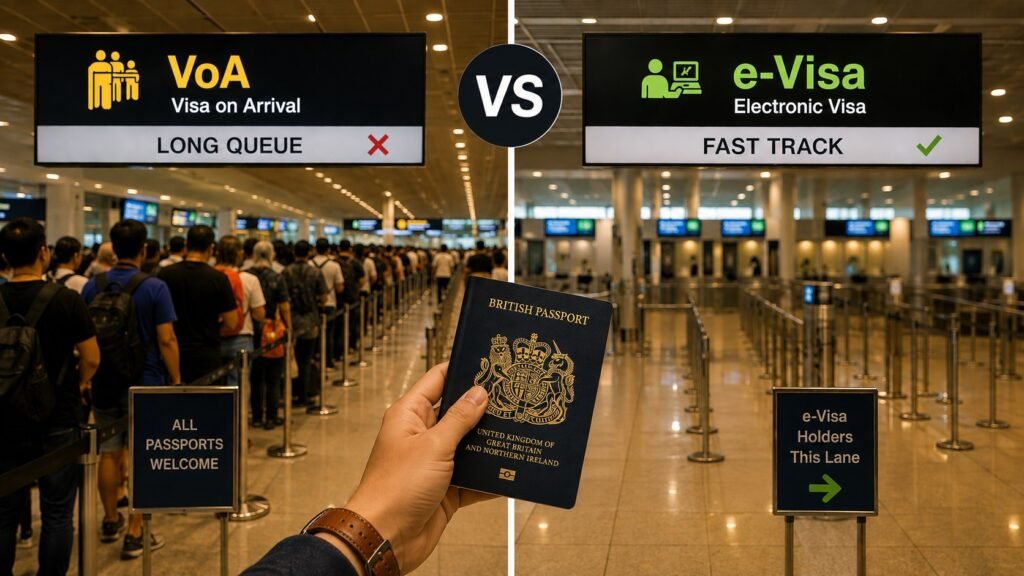
The short answer: the e-Visa wins for most travelers. You apply before you leave home, you get approved in writing, and you walk straight to the regular immigration lane when you land. Visa on Arrival is only for a specific group of nationalities and even then, the e-Visa is still the smarter option if you have a few days to spare before your trip.
Here’s everything you need to know to pick the right one.
First, Check If You Even Need Either One
Before comparing these two options, check whether you actually need a visa at all.
Thailand has a visa exemption program. If your passport is from the US, UK, Canada, Australia, most of Europe, Japan, South Korea, or many other countries, you can enter Thailand with no visa and no application. You just show up at the airport. Currently that gives you up to 60 days, though Thailand’s government approved a plan to reduce that to 30 days – confirm the current rule before you book, since the exact start date was still being finalized as of mid-2026.
If you’re from an ASEAN country like Malaysia, Singapore, or Indonesia, you’re also covered under a visa exemption.
If your country is NOT on the exemption list, you’ll need either a Visa on Arrival or an e-Visa. Keep reading.
What Is Thailand’s Visa on Arrival?
Visa on Arrival (VoA) is a visa you get after you land. There’s a separate counter at the airport, just for VoA applicants. You fill out a form, hand over your documents, pay the fee in cash, and an officer decides on the spot whether to let you in.
VoA is only available to certain nationalities – countries like the Maldives, Bhutan, and a handful of others that have a specific bilateral arrangement with Thailand. It is not available to everyone. If your country isn’t on the VoA eligible list and you’re not visa-exempt, you need an e-Visa. There’s no other option.
Key VoA facts:
- Stay: up to 15 days (the day you arrive counts as day one)
- Fee: 2,000 Thai Baht, paid in cash at the airport – Thai Baht only, no cards, no foreign currency
- Can be extended: once, for 7 more days, at a Thai immigration office
- Maximum total stay: 22 days
What Is a Thailand e-Visa?
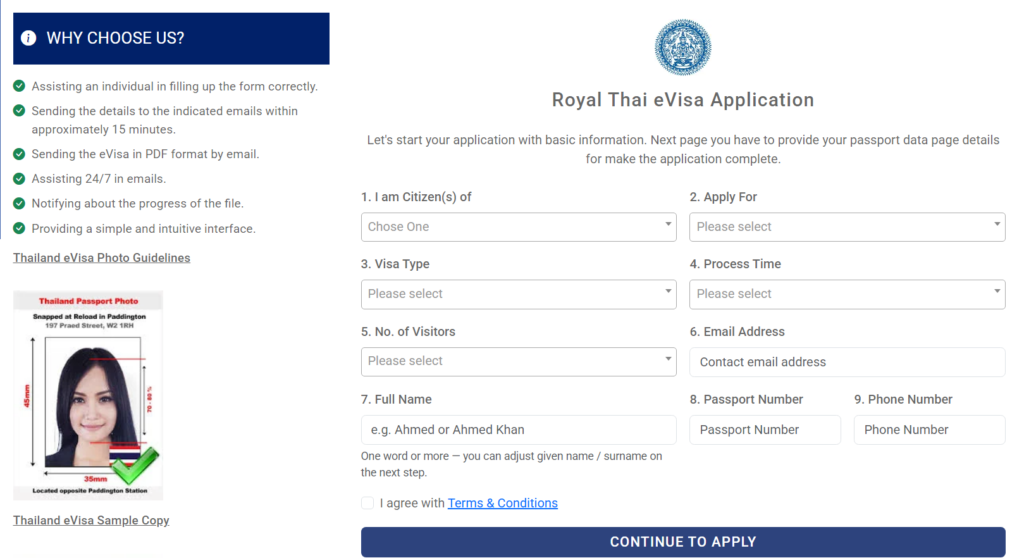
A Thailand e-Visa is a visa you apply for before you travel. You do it online – upload your documents, complete the form, and wait for a decision. When you’re approved, you get a PDF confirmation. You show that at check-in and again at immigration when you arrive.
Royal Thai Embassy offers two types of Tourist e-Visa:
Single Entry e-Visa — Valid for 3 months from the date it’s issued. Lets you stay up to 30 days. Can be extended by 30 days at a Thai immigration office once you’re in the country.
Multiple Entry e-Visa — Valid for 6 months. You can enter and exit Thailand as many times as you like during that period. Each visit allows a stay of up to 60 days, with an optional 30-day extension.
Processing typically takes 3 to 5 working days. If you need it faster, urgent processing is available.
The e-Visa is open to a much wider range of nationalities than the VoA – including countries like Bangladesh, Nigeria, Pakistan, Nepal, Egypt, Venezuela, Myanmar, and many others across Africa, the Middle East, Central Asia, and the Caribbean. You can check the full eligible country list on the Royal Thai Embassy website.
Side-by-Side Comparison
| Visa on Arrival | e-Visa | |
|---|---|---|
| Where to apply | Airport counter, after landing | Online, before you travel |
| Who qualifies | Limited nationalities only | Wider range of nationalities |
| Stay duration | 15 days | 30 days (Single) / 60 days (Multiple) |
| Fee | cash at airport | Check current fees |
| Can be extended? | Yes, once (7 days) | Yes, once (30 days) |
| Risk of denial | Yes — decided on the spot | Lower — approved before you fly |
| Processing | Immediate, but wait in queue | 3–5 working days |
| Airport experience | Separate VoA queue | Standard immigration lane |
| Multiple entries | No | Yes (with Multiple Entry e-Visa) |
The Real Differences Nobody Mentions
The VoA queue takes time
At Bangkok’s Suvarnabhumi Airport during peak season, the Visa on Arrival line can run well over an hour. You’ve just landed after a long flight. You’re tired. And you’re standing in a slow-moving line while travelers with pre-approved visas walk straight through. That’s a real cost – it just doesn’t show up anywhere on the official fee page.
Smaller airports like Phuket or Chiang Mai tend to move faster, but it varies. During busy travel periods, plan for a wait.
You need Thai Baht cash — nothing else
The VoA fee is 2,000 THB. Cash only. Thai Baht only. Credit cards are not accepted. Some officers may take USD, but that’s not guaranteed and the exchange rate won’t be in your favor.
If you arrive without Thai Baht, you’ll need to exchange money before you join the VoA queue. There are exchange booths near the counter at Suvarnabhumi – but this is something to plan for before you land, not scramble for after a long flight.
VoA can be denied
It doesn’t happen often, but it happens. An officer looks at your documents and makes a judgment call. If your passport validity is low, your accommodation booking looks questionable, your return ticket is missing, or you can’t show enough funds – they can refuse you entry. At that point you’re waiting in a holding area for the next flight out.
With an e-Visa, you have written approval before you ever board the plane. That peace of mind alone is worth a lot, especially when you’ve already paid for flights and a hotel.
Officers may ask to see your funds
Thai immigration officers can ask any traveler — VoA or e-Visa — to show that they have enough money for their trip. A general expectation is around 10,000 THB per person (roughly $270 USD), or 20,000 THB per family. It’s not always checked, but be ready for it.
Airport brokers will offer to “help”
At some airports, you may be approached by people offering to handle your VoA for a fee. Some charge as much as the visa itself on top of the official cost. You don’t need them. Go straight to the official VoA counter and do it yourself.
Which One Should You Choose?
Choose Visa on Arrival if:
- Your nationality qualifies for VoA specifically
- You’re traveling on very short notice and have no time to apply in advance
- You only need 15 days in Thailand (22 with an extension)
- You have 2,000 THB in Thai Baht ready before you land
Choose the e-Visa if:
- You want to know you’re approved before you board the plane
- You need more than 15 days in Thailand
- You want to skip the VoA queue at the airport
- You’re traveling during peak season when lines are long
- You plan to leave and re-enter Thailand (Multiple Entry)
- Your nationality isn’t on the VoA list
For most people with even a week of lead time, the e-Visa is the better move. You spend a few minutes on the application, wait a few days, and your entry is sorted. No queues, no cash scramble, no uncertainty at the immigration counter.
Don’t Forget the TDAC
Both VoA and e-Visa holders are required to complete the Thailand Digital Arrival Card (TDAC) before departure. Think of it as the digital version of the paper arrival card — it’s not the same as your visa, and it’s not optional.
You need to submit it at least 72 hours before your flight. Some airlines now check for the TDAC QR code at check-in. If you don’t have it, you may be denied boarding before you even get to Thailand.
It’s free and takes just a few minutes. Complete it at the TDAC page before you travel.
Want to Stay Longer?
If you entered on VoA: You can extend once, for 7 days, at any Thai immigration office. That gives you 22 days maximum. After that, you’d need to leave Thailand and re-enter on a different visa — or plan ahead with an e-Visa next time.
If you entered on a Single Entry e-Visa: You can extend your stay by 30 days at a Thai immigration office, bringing your total to 60 days.
If you entered on a Multiple Entry e-Visa: Each visit allows up to 60 days, with a 30-day extension available. You can leave and re-enter multiple times within the 6-month validity.
If you’re planning a longer trip from the start, the Multiple Entry Tourist Visa is worth looking into before you apply.
How to Apply for a Thailand e-Visa
The process is straightforward:
- Check that your country is eligible on the Royal Thai Embassy website
- Gather your documents — passport biodata page, a recent photo, travel booking, and proof of accommodation. See the full document checklist before you start
- Fill out the online application and upload your documents
- Pay the visa fee and submit
- Wait 3 to 5 working days for your approval PDF
- Complete your TDAC at least 72 hours before your flight
- Show your e-Visa PDF and TDAC QR code at check-in and at immigration
Apply at least two weeks before you travel to give yourself a comfortable buffer. If you’re cutting it close, urgent processing is available.
Royal Thai Embassy can help you through the application from start to finish.
Frequently Asked Questions
Can I extend a Visa on Arrival in Thailand? Yes, once. Go to any Thai immigration office and apply for a 7-day extension before your VoA expires. That brings your maximum stay to 22 days. You cannot extend it a second time.
How long does the Thailand e-Visa take to process? Usually 3 to 5 working days for a standard application. Weekends and Thai public holidays don’t count as working days, so factor those in. Apply at least two weeks before your travel date. Check current processing times for the latest information.
What documents do I need for Visa on Arrival at the airport? A passport valid for at least 30 days from your arrival date, a completed arrival form, proof of accommodation, a return or onward flight ticket, and 2,000 THB in cash. Officers may also ask to see proof of funds. Review the document checklist before you fly.
Do I still need a TDAC if I have an e-Visa? Yes. The TDAC is required for all international arrivals to Thailand regardless of visa type. It’s a separate requirement. Complete it at least 72 hours before departure at the TDAC page.
What happens if my Visa on Arrival is denied? If an officer denies your VoA at the airport, you won’t be allowed to enter Thailand. You’ll likely be held until the next available flight out. This is a real risk — and one of the strongest reasons to use an e-Visa if you can. An approved e-Visa means you know where you stand before you board.
Is the e-Visa valid for multiple entries? The Single Entry e-Visa allows one entry only. If you plan to leave Thailand and return during your trip, apply for the Multiple Entry e-Visa instead.