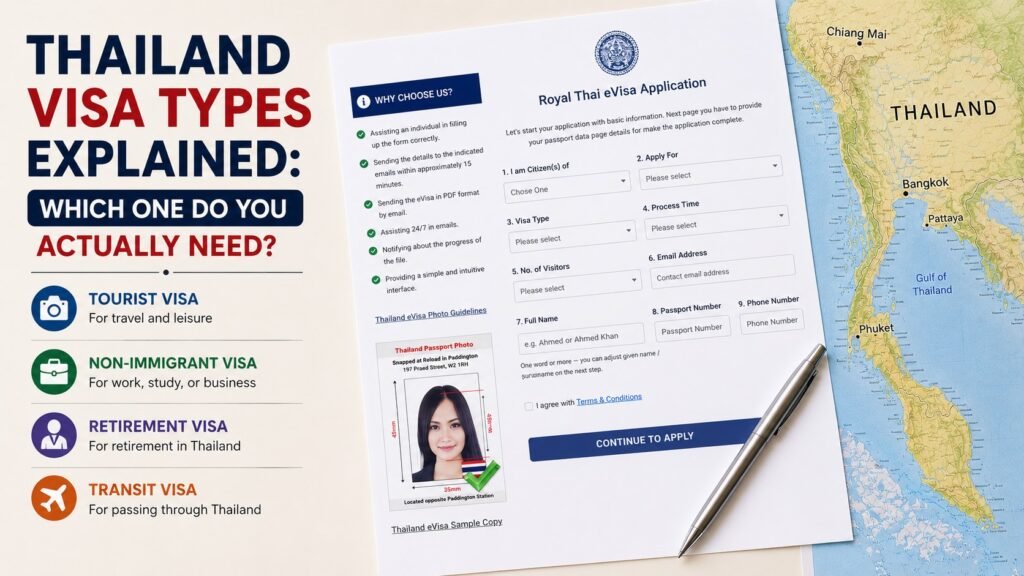
Thailand has around 15 different visa types. For most travelers, that list is way longer than it needs to be.
The truth is, the majority of people planning a trip to Thailand need one of just three options: the tourist eVisa, the Destination Thailand Visa (DTV), or a Non-Immigrant visa for work or study. A big chunk of nationalities don’t even need a visa at all.
This guide breaks down every visa type in plain language so you can figure out which one fits your situation and get your application moving.
Quick Reference: Which Thailand Visa Do You Need?
| Your Situation | Visa Type | Max Stay Per Entry |
|---|---|---|
| Short holiday or first trip | Tourist eVisa (Single Entry) | 60 days |
| Multiple visits in one year | Tourist eVisa (Multiple Entry) | 60 days per visit |
| Remote work or digital nomad | Destination Thailand Visa (DTV) | 180 days |
| Business meetings (no paid work) | Tourist eVisa | 60 days |
| Employment with a Thai company | Non-Immigrant B (Work Visa) | 90 days (renewable) |
| Enrolled student or training | Non-Immigrant ED (Study Visa) | 90 days (renewable) |
| Visiting a Thai spouse or family | Non-Immigrant O (Family Visa) | 90 days (renewable) |
| Retirement or long stay (50+) | Non-Immigrant OA or OX (Long Stay) | 1 year |
| Wealthy retiree or skilled professional | Long-Term Resident Visa (LTR) | Up to 10 years |
| Tech talent, investor, or startup founder | Smart Visa | Up to 4 years |
| Passing through Thailand | Transit Visa | 30 days |
Do You Even Need a Visa? Check This First
Before you go any further, check whether your country qualifies for visa exemption. If it does, you can enter Thailand without applying for anything in advance.
Citizens from the US, UK, Canada, Australia, Germany, France, Japan, South Korea, and most EU countries can enter Thailand visa-free for tourism. Depending on your nationality, that is anywhere from 30 to 60 days without any paperwork.
Most ASEAN countries are also exempt, including Malaysia, Singapore, Indonesia, the Philippines, Vietnam, Laos, Cambodia, and Brunei.
If your country is on the exemption list, you simply show up at the border with a valid passport and proof of onward travel.
Some nationalities, such as those from Maldives and Bhutan, can get a Visa on Arrival at the airport for up to 15 days. This is done at the immigration counter when you land, not in advance.
If your country is NOT on either of those lists, you will need to apply for a visa before you travel. That is where the options below come in.
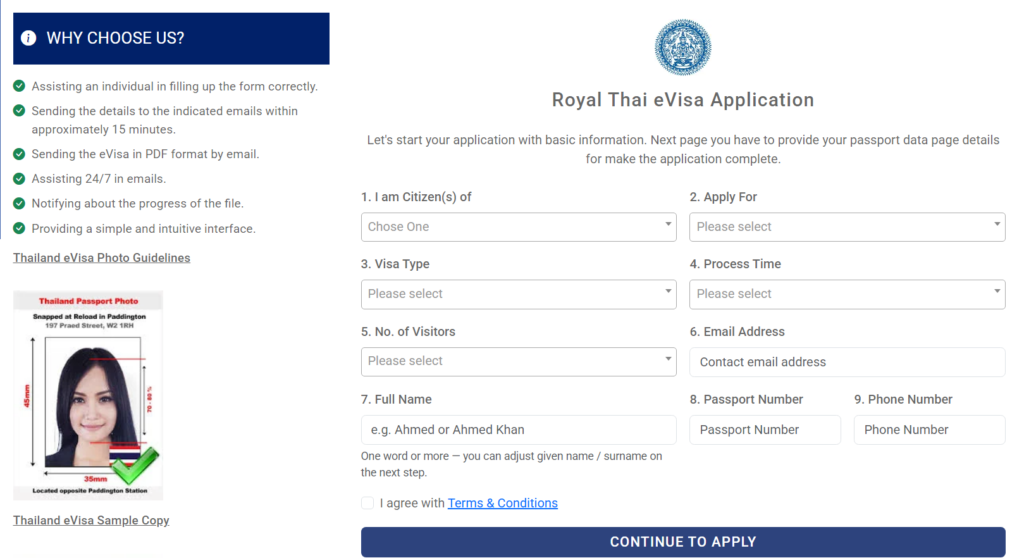
The Thailand Tourist eVisa
This is the most common visa for international travelers. If you are coming to Thailand for a holiday, a medical trip, a conference, or just to explore, this is almost certainly the one you need.
There are two versions.
Single Entry eVisa (SEV)
The Single Entry eVisa lets you enter Thailand once and stay for up to 60 days. It is valid for 6 months from the date it is issued, so you have a window to plan your arrival.
Once you are in the country, you can extend your tourist visa once at a local Thai immigration office for an additional 30 days. That gives you a maximum of 90 days total on a single entry.
When you leave Thailand, the visa expires. You would need a fresh application if you want to come back.
Best for: First-time visitors, travelers making one trip per year, anyone staying 60 days or less.
Multiple Entry eVisa (MEV)
The Multiple Entry eVisa lets you enter and exit Thailand as many times as you want within a 6-month window. Each visit allows a stay of up to 60 days, with the same 30-day extension option available per trip.
This is a good option if you plan to spend time in nearby countries like Vietnam or Laos and want to come back to Thailand in between.
Best for: Frequent visitors, travelers doing regional Southeast Asia trips, anyone who wants flexibility.
You can read a full breakdown of the 60-day Thai tourist visa if you want more detail on how the stay limit works.
The Destination Thailand Visa (DTV)
The DTV is the newest visa in Thailand’s lineup and probably the most talked about. It launched in July 2024 and is aimed at remote workers, freelancers, and people who want to stay long term while doing approved activities.
It is valid for 5 years and allows multiple entries. Each entry gives you 180 days in the country. You can also extend each stay once for another 180 days, which means you could potentially stay up to 360 consecutive days on a single entry.
That is a significant amount of time compared to any other tourist-category visa.
Who qualifies for the DTV?
The DTV is for people who fall into one of these situations:
- Remote workers and freelancers earning income from clients or companies outside Thailand
- People attending approved Thai soft power activities: Muay Thai training, Thai culinary programs, wellness retreats, and medical treatment
- Spouses and children under 20 of DTV holders
To apply, you need to prove you have at least 500,000 THB (roughly $14,000 USD) in your bank account. You also need to provide proof of your remote work arrangement or your enrollment in an approved activity.
Important limits of the DTV
The DTV does NOT give you the right to work for Thai companies or take on Thai clients. You cannot get a Thai work permit on a DTV. It is classified as a special tourist visa, not a work authorization.
As of 2026, Thai language school enrollment is no longer accepted as a qualifying activity. You need to enroll in a cultural, wellness, or medical program instead.
Processing also takes longer than a standard tourist visa, usually three to four weeks, because officials verify your employment and financial documents more carefully.
See the full guide on the Destination Thailand Visa on the Royal Thai Embassy site.
Best for: Digital nomads, remote employees, freelancers with foreign income, frequent long-stay visitors.
Work and Business Visa (Non-Immigrant B)
If you have a job offer from a Thai employer, you are being seconded to Thailand, or you plan to do any paid work while you are there, you need a Non-Immigrant B visa.
This is not the same as attending a business meeting. A tourist eVisa is usually fine for meetings, conferences, and trade fairs where you are not earning income from a Thai source.
The Non-Immigrant B is issued as a 90-day single entry visa and must be obtained before you arrive. Once in Thailand, your employer helps you convert it into a longer-term Non-Immigrant B with an annual extension, combined with a work permit.
You cannot legally work in Thailand without a work permit. Doing so on a tourist visa is a serious violation of Thai immigration law and can result in deportation and a ban from re-entry.
If you need a work permit after arriving, check the guide on how to get a Thai work permit.
For people coming strictly for business meetings with no employment involved, read through the Thailand visa for business travel page for more detail.
Best for: Employees of Thai companies, foreign workers with a Thai work permit, expats on employment contracts.
Studying Visa (Non-Immigrant ED)
If you are enrolling in a Thai university, an accredited language school, or an approved training program, you need the Non-Immigrant ED visa.
This is a 90-day single entry visa. Once you are enrolled and inside Thailand, your institution typically helps you apply for annual extensions so you can complete your program.
You will need an enrollment letter from your school and proof that the institution is approved by the Thai Ministry of Education.
Royal Thai Embassy has a full walkthrough on how to get a student visa through the Royal Thai Embassy if you are going through the application process.
Best for: University students, language school students, vocational training participants.
Staying with Family Visa (Non-Immigrant O)
If you are the spouse, parent, or dependent child of a Thai national or a foreigner with legal residency in Thailand, the Non-Immigrant O is the right choice.
It is also used by parents of Thai citizen children and by people who want to stay in Thailand without working or studying.
This visa is issued for 90 days and can be extended at a Thai immigration office.
See the details on the staying with family visa page.
Best for: Spouses of Thai nationals, dependent family members, parents of Thai citizens.
Long Stay Visa: Non-OA and Non-OX (Retirement Visa)
Thailand’s Long Stay Visas are designed for retirees and older travelers who want to stay long term.
Non-Immigrant OA: For people aged 50 and over. Issued for 1 year and can be renewed annually. You need to show proof of health insurance that meets Thai government requirements and either a monthly pension income or a lump sum in a Thai bank account.
Non-Immigrant OX: A less common version that allows a longer initial stay without needing annual renewals as frequently. It is available to citizens of a smaller set of countries.
Both visas require financial proof, so make sure you check the current requirements carefully before applying. The Thai visa financial proof guide covers what documents you need.
Best for: Retirees aged 50 and over who want to live in Thailand long term.
Long-Term Resident Visa (LTR)
The LTR is Thailand’s premium long-stay option. It is a 10-year visa with multiple entry rights and some additional benefits around tax and fast-track immigration services.
It is available to four types of applicants:
- Wealthy global citizens: High-net-worth individuals with significant assets and passive income
- Wealthy retirees: Retirees with qualifying investment or pension income
- Remote workers: Employed professionals working for reputable foreign companies with a minimum income threshold
- Highly skilled professionals: Experts in targeted industries like science, technology, manufacturing, or healthcare
The income and asset requirements are high. This is not a visa for everyone, but if you qualify, it offers some of the most flexible long-term stay rights available in Thailand.
Full details are on the Long-Term Resident Visa page.
Best for: High-income retirees, senior remote employees, high-skill professionals in targeted sectors.
Smart Visa
The Smart Visa is for people who bring specific value to Thailand’s economy. There are four categories:
- SMART-T (Talent): Highly skilled experts in targeted industries
- SMART-I (Investor): People making qualifying investments in Thai technology businesses
- SMART-E (Executive): Senior executives at companies in targeted sectors
- SMART-S (Startup): Founders of startups in government-approved incubator programs
Smart Visa holders can stay up to 4 years, bring their family, and skip the 90-day reporting requirement that most long-stay visa holders deal with.
The Smart Visa page explains which industries qualify and what the income and investment thresholds look like.
Best for: Tech professionals, investors in Thai startups, senior executives, innovation-sector founders.
Transit Visa
If you are passing through a Thai airport and need to leave the secure zone, or if you are connecting through Thailand to another country, you may need a Transit Visa.
Many nationalities can transit through Thailand for up to 24 hours without any visa. But if your stopover is longer, or if you want to leave the airport, the Transit Visa gives you up to 30 days.
See the full details on the transit visa page.
Best for: Travelers with extended layovers, people connecting through Bangkok on multi-leg trips.
Other Visa Types
The visa page on Royal Thai Embassy also lists a few specialized categories that apply to smaller groups:
- Research and Science Visa: For researchers and scientists conducting approved projects in Thailand
- Religious Activities Visa: For ordained clergy and those participating in religious retreats
- Media and Film Crew Visa: For journalists, documentary crews, and commercial production teams
- Courtesy Visa: Issued to government officials and certain diplomatic visitors
These are not the visas most travelers need, but if one of these situations applies to you, each page has the specific requirements.
Can You Extend Your Visa Once You Are in Thailand?
In many cases, yes. Here is a quick summary by visa type:
| Visa Type | Can You Extend? | Where | Extra Time |
|---|---|---|---|
| Tourist eVisa (Single or Multiple) | Yes, once | Local immigration office | 30 days |
| DTV | Yes, once per entry | Local immigration office | 180 days |
| Non-Immigrant B (Work) | Yes, annually | Immigration Bureau | 1 year |
| Non-Immigrant ED (Study) | Yes, annually | Immigration Bureau | 1 year |
| Non-Immigrant O (Family) | Yes, annually | Immigration Bureau | 1 year |
| Non-OA / OX (Long Stay) | Yes, annually | Immigration Bureau | 1 year |
| LTR | Extended validity built in | No extension needed | Up to 10 years |
For tourist visa extensions, you go to the nearest Thai Immigration Office and apply in person. You will need your passport, a passport-sized photo, a completed TM.7 form, the extension fee, and proof of your accommodation.
The full process is covered in the extend Thai tourist visa 30 days guide.
What Happens If You Pick the Wrong Visa?
This is worth taking seriously. Thai immigration officers check your visa type against your stated purpose when you arrive. If the two do not match, they can deny you entry.
The most common problem is people who plan to work or freelance in Thailand but arrive on a tourist visa. Working on a tourist visa is illegal in Thailand. If you are caught, you can be fined, deported, and banned from re-entry.
Attending a business meeting on a tourist visa is generally fine. Signing a contract, doing paid work, or running a business locally is not.
If you are not sure which visa covers your situation, it is better to ask before you apply than to find out at the immigration counter.
Common Mistakes to Avoid
1. Applying for a tourist visa when you plan to work Even if the work is remote, you should look at the DTV instead of the tourist eVisa. Working on a tourist visa, even for foreign clients, sits in a legal grey area and some travelers have had problems at immigration.
2. Not checking your passport validity Thailand requires your passport to be valid for at least 6 months from your arrival date. If your passport expires sooner than that, renew it before you apply. This rule applies to all visa types. See the passport validity requirements guide for more.
3. Applying too early The tourist eVisa is typically valid for 6 months from the issue date. If you apply four months before your trip, you are fine. If you apply six months early, it may expire before you even arrive.
4. Forgetting the Thailand Digital Arrival Card (TDAC) Since January 2025, all travelers entering Thailand are required to complete the Thailand Digital Arrival Card before landing. This is separate from your visa. Skipping it can cause delays at immigration.
5. Missing documents in your application The most common rejection reason is incomplete or unclear documents. The Thai eVisa requirements page has the full checklist. Go through it before you submit.
Ready to Apply?
Now that you know which visa fits your trip, the next step is getting your application right the first time.
Royal Thai Embassy is a third-party visa application service that helps travelers prepare and submit their Thailand eVisa. The team reviews your documents, catches errors before submission, and handles the paperwork so you do not have to navigate the official portal alone.
If you have questions about which visa is right for your specific situation, the contact page has support available 24/7.
Frequently Asked Questions
Can I work in Thailand on a tourist visa? No. Working on a tourist visa is illegal in Thailand, whether that means working for a Thai company or doing freelance work for local clients. If you plan to work for foreign clients remotely, the Destination Thailand Visa (DTV) is the right option. If you have a job with a Thai employer, you need a Non-Immigrant B visa and a work permit.
What is the difference between a Single Entry and Multiple Entry eVisa? A Single Entry eVisa lets you enter Thailand once and stay up to 60 days. Once you leave, the visa is done. A Multiple Entry eVisa lets you enter and exit multiple times over 6 months, with each stay up to 60 days. The multiple entry is better if you plan regional travel and want to return to Thailand.
How long does a Thailand eVisa take to process? Standard tourist eVisas typically take 3 to 5 working days through Royal Thai Embassy. If you apply after 12:00 PM Thailand time, processing starts the next working day. Urgent processing is available if you need it faster. The DTV takes significantly longer, usually three to four weeks. See the Thailand eVisa processing time page for current timelines.
Can I extend my tourist visa inside Thailand? Yes. You can extend a tourist eVisa once at a local Thai Immigration Office for an additional 30 days. You need to do this before your current permitted stay expires.
Do US citizens need a visa for Thailand? No. US citizens can enter Thailand visa-free for up to 60 days under the visa exemption agreement. No application is needed in advance. Just bring a valid passport with at least 6 months of validity remaining.
What is the DTV and who qualifies? The Destination Thailand Visa is a 5-year multiple entry visa that allows 180-day stays per entry. It is designed for remote workers earning income from outside Thailand, and for people attending approved Thai cultural or wellness activities. You need to show a minimum bank balance of 500,000 THB to qualify. Full details are on the DTV page.
What documents do I need to apply for a Thailand eVisa? For most tourist eVisa applications, you need: your passport bio page, a recent passport photo, proof of your current address, flight booking confirmation, and proof of accommodation in Thailand. Some applicants may need financial statements as well. The full list is on the eVisa requirements page.